From broken PDF to Perfect Postal Piece in record time
Opens in new tab
PDF accessibility is no longer optional. Regulations and standards such as PDF/UA and WCAG are rapidly becoming mandatory across industries. As a result, for organizations producing large volumes of documents, accessibility is no longer just a technical requirement—it is an operational challenge.
PDFix set out to solve exactly that challenge: making accessibility remediation scalable, reliable, and efficient. However, achieving that goal is far from straightforward.
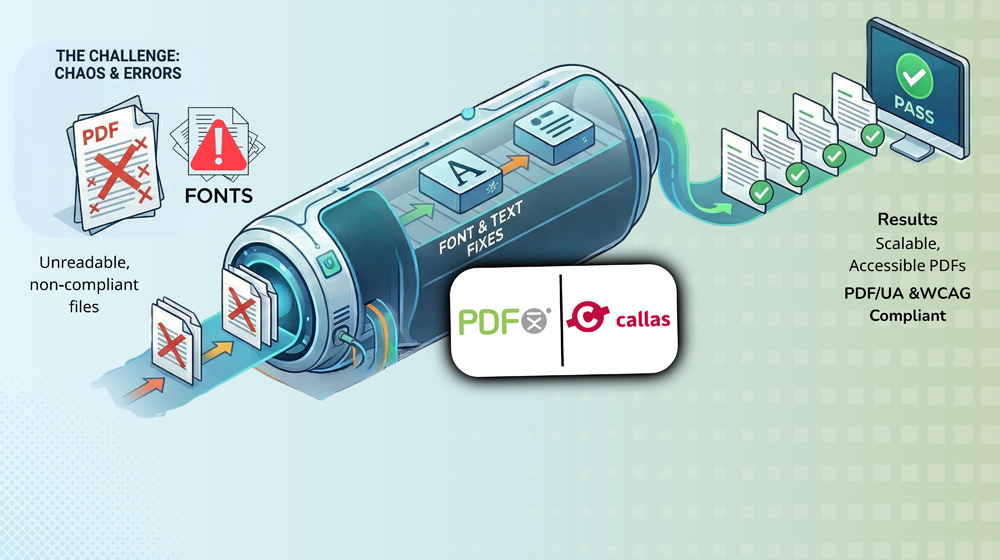
Accessible PDFs need to meet a wide range of technical requirements. They require correct structure and tagging, alternate descriptions for images, and properly defined metadata. However, one area consistently proves especially challenging: font handling.
For assistive technologies to interpret text correctly, fonts must not only be embedded but also contain an accurate mapping between visual characters and Unicode values. Without that mapping, screen readers cannot interpret text correctly. As a result, font-related issues are one of the most common reasons documents fail accessibility validation.
Ultimately, validation is what matters. For most organizations, accessibility comes down to a simple question: does the document pass validation or not? Does it get the green checkmark? When thousands—or even hundreds of thousands—of documents are involved, manual correction quickly becomes impractical. That’s why automation becomes essential.
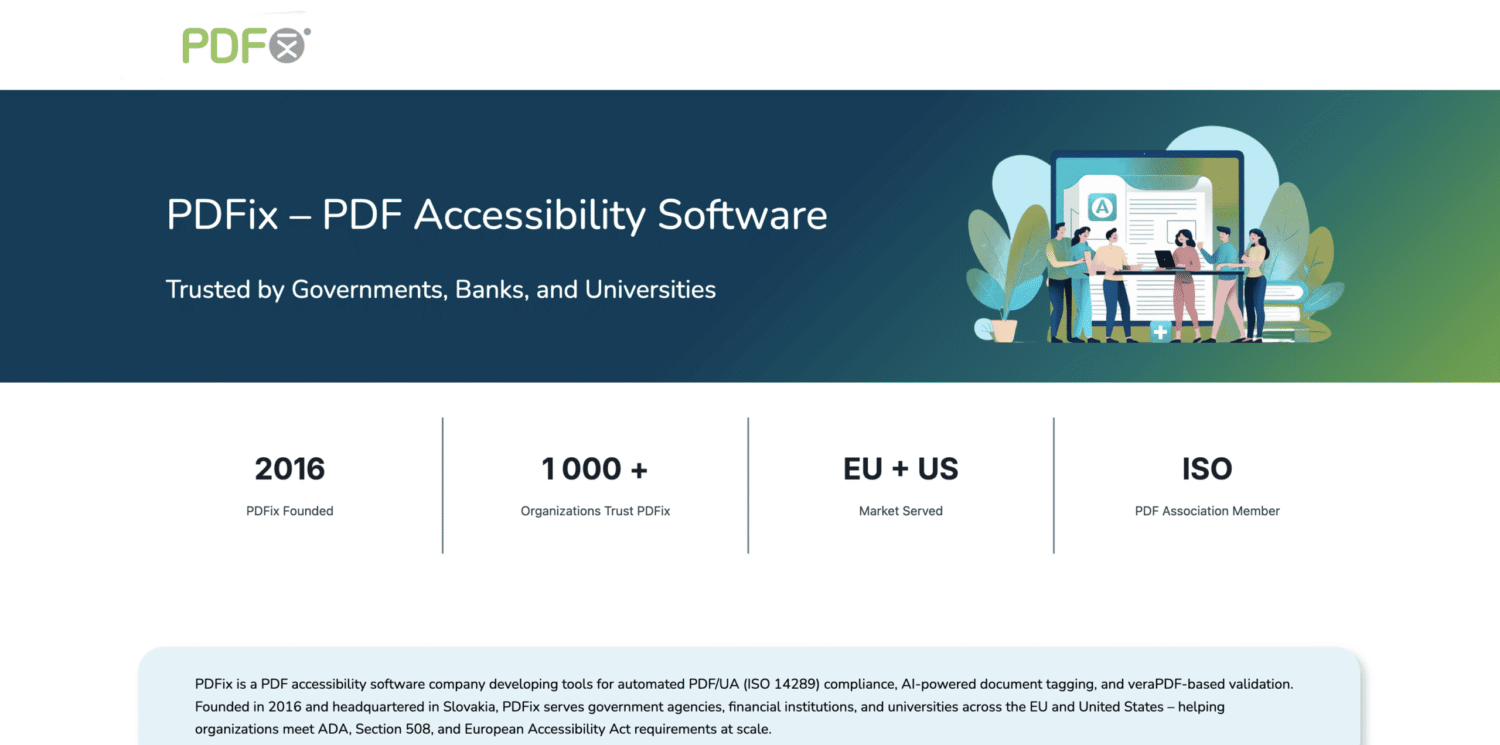
To address this challenge, PDFix developed a platform specifically designed for accessibility at scale. The technology is available in multiple forms:
Many PDFix customers operate in high-volume environments such as transactional printing, enterprise reporting, and large document archives. These environments typically generate documents from templates, which means the same issues tend to appear repeatedly.
Fortunately, that repetition makes automation particularly effective. Once a workflow is defined, organizations can apply it consistently across large document sets. At the same time, while automation can address many accessibility issues systematically, some challenges still require deep PDF expertise—especially when it comes to fonts.
It was at this point that PDFix encountered a critical challenge during the development of its platform.
Accessibility remediation requires extremely precise handling of fonts and text semantics. Implementing that level of PDF processing ourselves would have required years of development. By integrating callas pdfaPilot technology we were able to deliver reliable font fixes within months and focus our own development on accessibility workflows and automation.

This decision changed the trajectory of the project in two important ways: First, it provided access to proven, production-ready PDF technology to resolve complex font challenges quickly and reliably. Second, it removed the need to develop and maintain highly specialized font handling internally – a task that requires continuous updates and deep knowledge of the PDF specification.
Within the PDFix platform, callas technology is used to resolve complex font problems, including embedding missing fonts, ensuring correct Unicode mappings (ToUnicode tables), and repairing font structures and text-to-Unicode relationships within the PDF. These capabilities complement the accessibility validation and remediation features developed directly by PDFix.
To support scalable processing, PDFix built a modular architecture based on containerized execution. Automation actions are packaged as Docker containers, allowing functionality to be developed once and deployed consistently across different environments.
This approach enables:
Examples of automation actions include:
Importantly, this architecture supports local processing, allowing organizations to keep documents within their own environment – a key requirement for many customers. The pdfaPilot technology natively supports Linux and containerized environments, making it a natural fit for this architecture.
The impact of this approach becomes clear in large-scale projects. An example is the Judicial Council of California, which needed to process a very large archive of documents to meet accessibility requirements. The initial phase alone involved approximately 200,000 documents, all within a limited timeframe, followed by ongoing remediation of newly created content.
By combining PDFix accessibility technology with callas font correction capabilities, it became possible to process this volume efficiently and reliably. What would otherwise have required extensive manual effort was transformed into an automated workflow. Accessibility was no longer a bottleneck – it became a scalable, repeatable process.
Many of our customers need to process large volumes of documents and achieve clear accessibility validation results. By combining PDFix automation with callas technology for complex PDF fixes, we can deliver reliable remediation workflows that scale from individual documents to hundreds of thousands of files.
For organizations dealing with accessibility requirements, the goal is simple: documents that pass validation and meet compliance standards.
By combining deep accessibility expertise with proven PDF technology, PDFix enables customers to move from complex, error-prone processes to reliable, automated workflows.
The result is not just technical compliance – but the ability to deliver accessibility reliably, at scale.